
Industry Events 2011
Course: Uncertainty Management & Quantification in Industrial Analysis & Design
3rd - 4th March 2011, GE Global Research Centre, Munich, Germany
- & -
15th - 16th September 2011, Crowne Plaza Hotel, Hampton-Marina, Virginia, USA
Coordinator: Prof. Charles Hirsch, Numeca International, Belgium
Scope:
- Industry requirements and objectives for uncertainty quantification (UQ) and risk reduction with robust design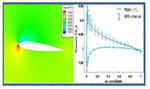
- Methodologies for UQ and for robust design under uncertainties
- Examples of applications and test cases with prescribed uncertainties
- Introduction to robust design methodologies
- Presents the state of the art and outlook for next Technology Readiness Level (TRL), including an introduction to a best practice guide for UQ
Course: Transition Modelling
25th - 26th May 2011, GE Global Research Centre, Munich, Germany
Coordinator: Prof. Erik Dick, University of Ghent, Belgium
Scope:
- An overview of transition modelling approaches 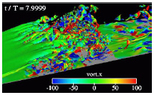
- A discussion of transition mechanisms
- Detailed discussion of approaches, dependent on the application area
- Recommendations for appropriate and effective application of transition models
Course: CFD for Dispersed Multi-Phase Flow (in collaboration with SIAMUF)
7th - 8th June 2011, Innventia, Stockholm, Sweden
Coordinator: Prof. Martin Sommerfeld, Universitat Halle-Wittenberg, Germany
Scope:
- Provide fundamental background knowledge on fluid mechanics of dispersed multi-phase 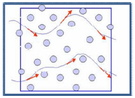 flows
- Discuss engineering models for dispersed multi-phase flow problems and their translation into CFD problems for Euler-Euler and Euler-Lagrange formulations
- Provide guidance on best practices
Course: Flame Stabilization for Industrial Burners
26th - 27th September 2011, GE Global Research Centre, Munich, Germany
Coordinator: Prof. Dirk Roekaerts, TU Delft, The Netherlands
Scope:
- General principles of burner design
- Scaling rules for different burner designs 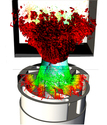
- Relation between flow-chemistry interaction and extinction and ignition
- Modeling methods
- Experimental techniques
- Modern developments
Course: Design Optimisation – Methods and Applications
15th - 16th November 2011, Cassidian, Manching, Germany
Coordinators: Prof. Kyriakos Giannkoglu, NTUA, Greece
Dr. Werner Haase, Haase Consultancy, Germany
Scope:
- An overview of modern design optimisation methods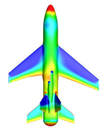
- Comprehensive discussions on the presented methods including their pros and cons, assisting industrial engineers to select the best-suited approach for solving their particular problems
- Based on the latter topic, successfully treated examples in the areas of aeronautics, the automotive, and the turbo-machinery industry will be presented and thoroughly discussed.
Course: RANS and Hybrid RANS-LES Methods in Industrial CFD -Overview, Guidance and Examples
October/November 2011 (a four day event ), GE, Cleveland, Ohio, USA
Coordinators: Prof. Anthony Hutton, ERCOFTAC
Dr. Charles Mockett, TU Berlin
Scope:
- An overview of turbulence modelling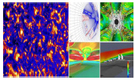
- A firm foundation in the theory and ideas underlying RANS, LES and Hybrid RANS-LES techniques
- Recommendations and guidance for the appropriate and effective application of RANS and Hybrid RANS-LES
- Examples from real-world engineering simulations
 Pilot Centres
 Special Interest Groups
 Knowledge Base Wiki
 ERCOFTAC Membership