ERCOFTAC Course
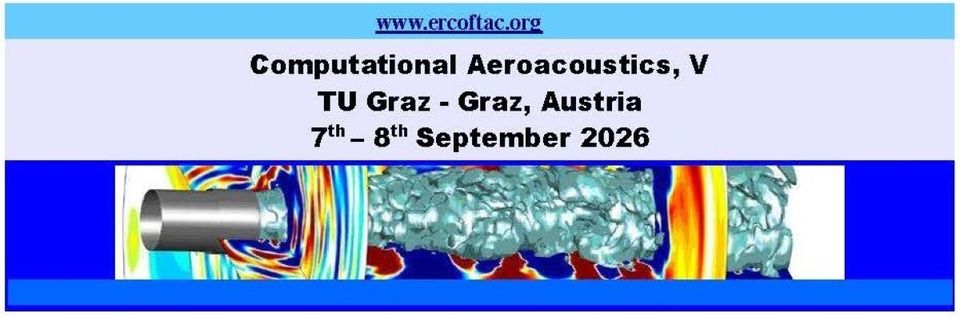
REGISTRATION IS NOW OPEN !!!
Online participation is now also available however in-person attendance is preferred
Location:
- In person at Graz University of Technology (TU Graz). In-person attendance is encouraged.
- Online: if you are unable to attend in person, a link to the lectures will be provided upon request; however, the registration fee will remain unchanged.
Fee's structure:
ERCOFTAC Members:
- €110 - Undergraduate Students: ERCOFTAC members
- €260 - PhD students: ERCOFTAC members
- €460 - Universities & Research Center Staff: ERCOFTAC members
- €660 - Commercial Organizations Staff ERCOFTAC members
Non - Members:
- €120- Undergraduate Students: non ERCOFTAC members
- €285- PhD students: non ERCOFTAC members
- €510- Universities & Research Center Staff: non ERCOFTAC members
- €735- Commercial Organizations Staff non ERCOFTAC members
Registration:
Registration and payment of the fee for participation in the course can be made through this webpage: ERCOFTAC - Computational Aeroacoustics, V
or alternatively by contacting ERCOFTAC CADO: admin@cado-ercoftac.org
Organizers:
- Dr Christophe Bogey, LMFA UMR 5509, Ecole Centrale de Lyon, France
- Prof Stefan Schoder, Institute of Fundamentals and Theory in Electrical Engineering, TU Graz, Austria
This course is intended for researchers in industry and in academia including Ph.D. Students with a good knowledge in fluid mechanics, who would like to build up or widen their knowledge in the field of aeroacoustics (modelling, computational tools and industrial applications).
It will provide:
- a comprehensive overview of aeroacoustic theories (Lighthill analogy and vortex sound theory, FWH analogy, hybrid approaches, wave extrapolation methods, duct acoustics);
- the issues of the direct computation of aerodynamic noise using CFD methods (Large Eddy Simulation, Lattice-Boltzmann Method).
It will be discussed:
- a number of practical problems involving the coupling between CFD and CAA (e.g. how design a mesh size for aeroacoustics applications, inclusion of mean flow effects via hybrid formulations such as the acoustic perturbation equations, presence of surfaces, aero-acoustic couplings);
- realistic applications performed by the instructors (aeronautics, car industry, propulsion, energy);
- advanced computational aeroacoustics methods, as well as what we can learn from the direct computation of aerodynamic noise, will be presented;
- specific topics reflecting participant interests.
Lecturers:
- Dr Christophe Bogey, Ecole Centrale de Lyon, France, christophe.bogey@ec-lyon.fr
- Pr Gwenael Gabard, LAUM, Le Mans Université, France
- Dr Alois Sengissen, Airbus Avions, France
- Pr Stefan Schoder, TU Graz, Austria, stefan.schoder@tugraz.at
- Pr Wolfgang Schröder, Institute of Aerodynamics, Aachen, Germany
Monday, 7th September 2026
08:00 – Registration & Coffee
08:30 – Acoustic sources, Lighthill and FWH analogies (S. Schoder)
09:30 – Vortex sound theory (S. Schoder)
10:30 – Refreshments
11:00 – Direct noise computation (C. Bogey)
12:00 – Lunch
14:00 – Examples of direct aerodynamic noise predictions(C. Bogey)
15:00 – Aeroacoustic simulations with unstructured grids (G. Gabard)
16:00 – Refreshments
16:30 – Duct acoustics (G. Gabard)
17:30 – Q&A
18:00 – Close
Tuesday, 8th September 2026
08:00 – Coffee
08:30 – Hybrid APE/LES Analysis: Part I Theory (W. Schröder)
09:30 – Hybrid APE/LES Analysis: Part II Airframe, Jet, and Combustion Noise (W. Schröder)
10:30 – Refreshments
11:00 – Lattice-Boltzmann Methods for aeroacoustics: theoretical background (A. Sengissen)
12:00 – Lunch
13:30 – Lattice-Boltzmann Methods for aeroacoustics : industrial applications (A. Sengissen)
14:30 – Q&A
15:30 – Close
 Pilot Centres
 Special Interest Groups
 Knowledge Base Wiki
 ERCOFTAC Membership