18th ERCOFTAC Da Vinci Competition 2023 - Interview with Da Vinci Finalists
Esther Lagemann - Mäteling
(RWTH Aachen University, Germany)
Modal Scale Decomposition in Turbulent Flows
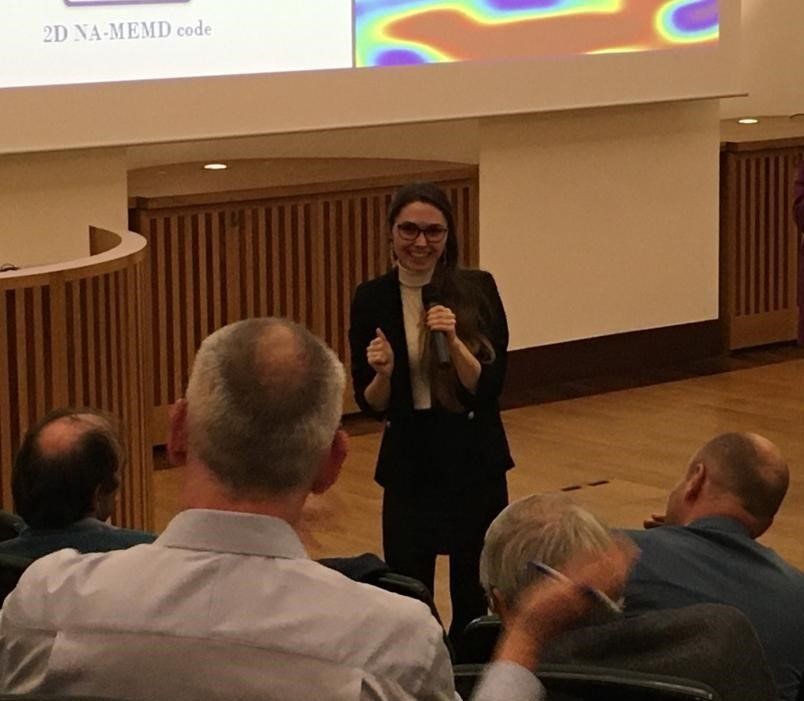
Esther Lagemann - Mäteling - finalist
of 18th Da Vinci Competition 2023
- What is the topic of your Ph.D. thesis?
In my Phd, I developed a novel data-driven decomposition method particularly suited for turbulent flows. In contrast to the majority of decomposition methods that we typically use in our fluid dynamics community, this so-called 2D noise-assisted multivariate empirical mode decomposition is able to adequately deal with the challenging characteristics of turbulent flows – non-linearity, unsteadiness, and multi-scale interactions. The algorithm takes temporally and spatially resolved multi-component data, for example, a time series of two-dimensional velocity fields, and separates these data into modal representations with a physically meaningful segmentation of the dynamical processes underlying the given data. The application to academic and real-world relevant fluid dynamical datasets, e.g., in the context of drag reduction of transportation systems like aircraft, highlights its great potential in advancing physically motivated analyses in a broad range of settings.
- What does the Da Vinci competition mean to you?
It is a great honor and privilege to be selected as a Da Vinci finalist as this is such a prestigious award in the European fluid dynamics community. Since we are all in a very early stage of our academic career, it was great to see that fluid dynamics experts appreciate our work as a valuable contribution to our community.
- What motivates you in your work?
There are still so many mysteries in nature that we do not entirely understand. I guess my curiosity to understand what is happing around us and also inside us as human beings is my motivation for fluid dynamics research. I am hoping to contribute a little puzzle piece to uncover what nature intuitively does and how we can use that for the benefit of society.
- Where do you see yourself in five years?
I definitely see myself working in academia and continuing with my research. Thus, I would be very grateful if I would have a faculty position at that time. I have a lot of ideas for prospective research projects and combining that with my passion for teaching would be great.
- What advice would you give to new PhD students starting in fluid mechanics?
Starting a PhD in fluid dynamics can be very overwhelming since it often requires a significant amount of fundamental knowledge in fluid dynamics, experimental or numerical methods, data analysis tools etc. before you can actually start to contribute to state-of-the-art research. Therefore, my advice is to be patient with yourself, take the time you need to familiarize with your PhD topic and ask your colleagues/supervisor(s) for support if needed. Just remember that nobody starts off being an expert. It takes time and dedication to pursue a PhD and I would recommend to find your niche that motivates you to wake up every day and continue with your research.
Da Vinci Presentation available here
Paper summary
Date: ERCOFTAC Autumn Festival 2023, 12th - 13th October 2023
Hosted by Pilot Centre Belgium: University of Liège, Belgium
 Pilot Centres
 Special Interest Groups
 Knowledge Base Wiki
 ERCOFTAC Membership